Tuesday, November 24, 2026 · On this day in 1974
Donald Johanson and Tom Gray discovered the 3.2 million-year-old remains of 'Lucy,' an Australopithecus afarensis, in Ethiopia
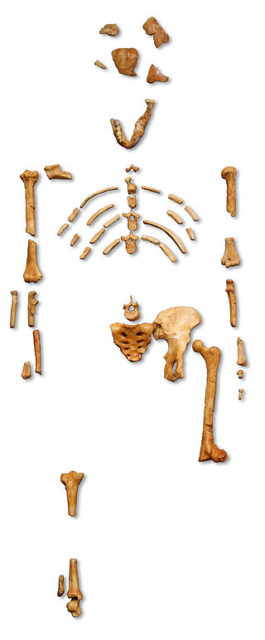
In 1974, a monumental discovery reshaped our understanding of human evolution when Donald Johanson and Tom Gray unearthed the 3.2 million-year-old remains of "Lucy" in the Afar region of Ethiopia. This famous fossil, classified as an Australopithecus afarensis, provided significant insight into the evolutionary lineage leading to Homo sapiens. Lucy's discovery was groundbreaking because her skeletal structure revealed that she walked upright, offering critical evidence of bipedalism in early hominids. Named after "Lucy in the Sky with Diamonds" by The Beatles, which was playing in the expedition camp, this finding by Johanson's team not only underscored the importance of the East African Rift Valley as a cradle of human ancestry but also prompted extensive research into the lifestyle and environment of early human ancestors.
The National Museum of Ethiopia in Addis Ababa now houses Lucy's remains, where they continue to captivate scientists and the public alike. This pivotal find has been instrumental in piecing together the complex puzzle of human evolution, inviting us to ponder the lineage that connects modern humans to our distant ancestors. Lucy remains a symbolic figure in paleoanthropology, bridging a profound gap in the story of humanity while reminding us of the ancient roots shared across humankind.
Edited by Chris Schuld