Friday, August 7, 2026 · On this day in 1944
IBM dedicated the Harvard Mark I, a program-controlled calculator developed by Howard H. Aiken and Grace Hopper
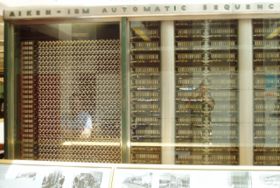
In 1944, IBM dedicated the first program-controlled calculator, the Automatic Sequence Controlled Calculator (ASCC), famously known as the Harvard Mark I. This monumental event marked a significant leap forward in the field of computing and technology, as the ASCC was one of the earliest machines capable of executing long computations automatically. Developed in collaboration with Harvard University, the machine weighed about five tons and was 51 feet long, composed of an intricate assembly of gears, cams, switches, and relay circuits with over 750,000 components. The Harvard Mark I was pivotal during its time, as it facilitated complex calculations used in military and scientific applications during World War II, illustrating the critical intersection of academia, industry, and government in technological advancements. Its dedication underscored the transition from mechanical to electromechanical computing, setting the stage for future innovations in digital computing, which would eventually lead to the modern computers that have become integral to countless aspects of society today.
Edited by Chris Schuld